When people say “AI race,” they hear company names: OpenAI, Anthropic, Google, DeepSeek, Mistral. That is understandable. Firms ship models, publish benchmarks, and collect subscriptions. If we stay only at the firm level, we miss the point.
Frontier AI now touches productivity, security, research, and geopolitics. States are not passive customers. They restrict chip exports, shape licensing, regulate who may deploy models, and decide whether a domestic ecosystem becomes dependent on foreign infrastructure. That is why this paper talks about Europe as a whole: a single market, shared regulation (AI Act), shared capital and energy constraints, and a bloc-level comparison against the United States and China.
1. Why AI in Europe is worth writing about
AI is a game changer, but already at state level, not at “who has the nicer chatbot.” States try to control AI because AI redraws the economic and security map. The US shows this clearly: limits on model and chip access are not marketing. They are geopolitical tools.
USA, Fable class models, and Anthropic
US frontier labs are building a world where the best closed models are not equally available to “the rest of the world.” Restrictions and compliance frames separate who may access what. That is not a product footnote. It is state logic: intelligence as a strategic commodity.
Anthropic’s public narrative goes further. The problem is not only “ban the rest of the world.” The problem is that if users lose access to Western models (or if labs tighten availability), they migrate to Chinese alternatives. Chinese open-weight models are read as a strategic threat: not only a benchmark rival, but a channel for adoption, data, and software ecosystems to move.
Working claim to keep pressure-testing with primary sources: Anthropic signals willingness to constrain global availability rather than risk users leaving for Chinese models. Fable-class releases matter because they intensify the fight over control and access at the same time closed labs eye IPO narratives.
For Europe, the uncomfortable question follows: if states and mega-labs with capital and chips run the race, what is left for the EU? Regulation without infrastructure? Applications without models? Does the EU have the ability to keep pace? And why yes, or why not?
2. European models vs the rest of the world
Benchmarks are not truth. They are the political and marketing language of the AI race. Still, without them we cannot compare whether European labs (often around open or European players such as Mistral and peers) keep pace with US closed labs and Chinese open labs.
What to measure (not one number):
- Raw capability (reasoning, coding, agentic tasks).
- Lag behind the frontier in months, not only absolute score.
- Inference cost and availability (API vs self-host).
- License and export limits: who may run the model at all.
- Dependence on foreign chips and cloud.
Thesis: Europe can have a solid mid-frontier and strong applications, but on the absolute frontier (newest US closed labs plus the fastest Chinese open jumps) it remains mostly a follower. The point of this section is the size and direction of the lag, not European triumphalism.
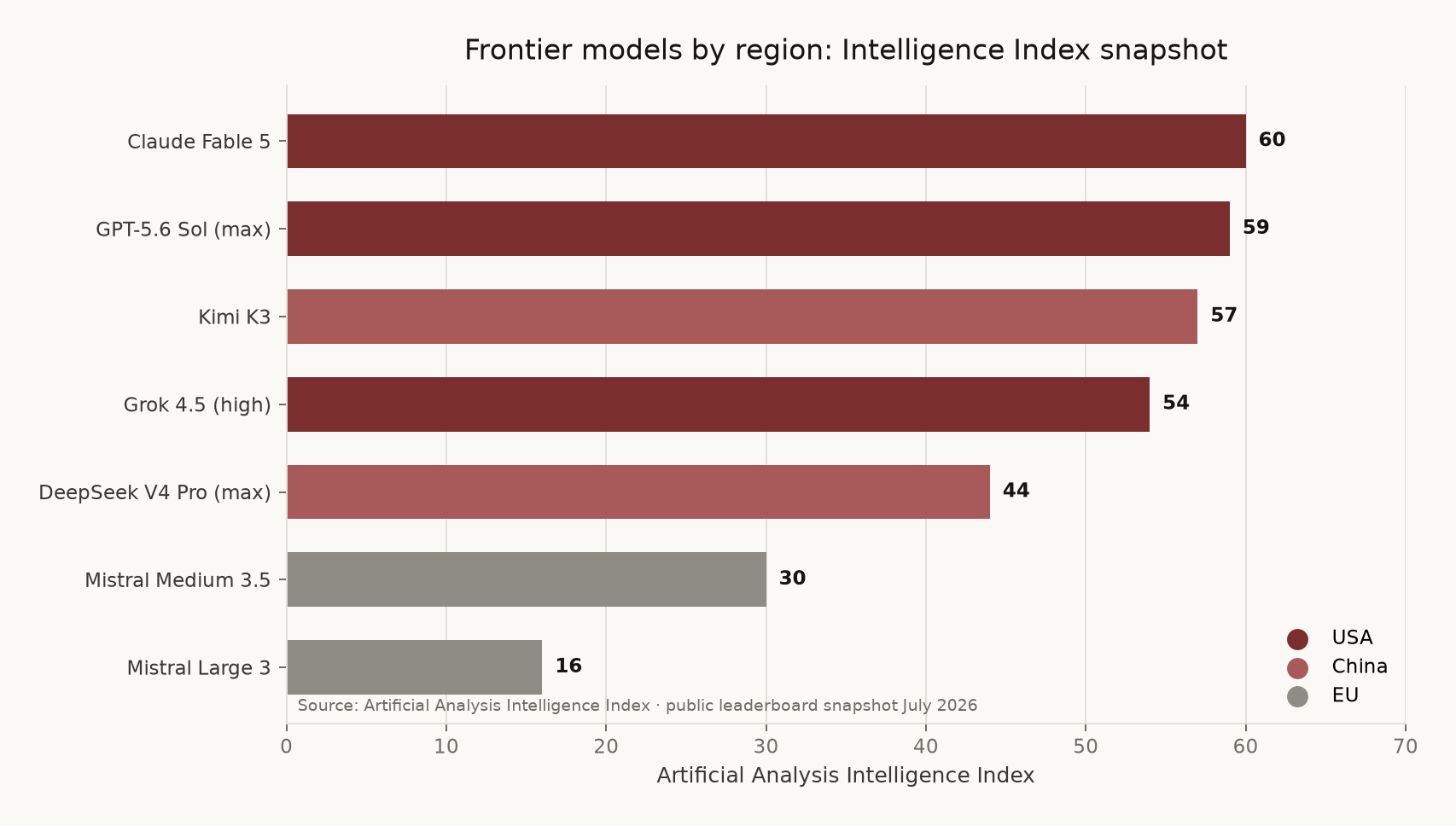
Figure 1. Named models by region on the Artificial Analysis Intelligence Index (public snapshot, July 2026). US closed frontier still leads. Kimi K3 shows China inside the top tier. European Mistral scores sit clearly below the frontier band. Source: Artificial Analysis leaderboard.
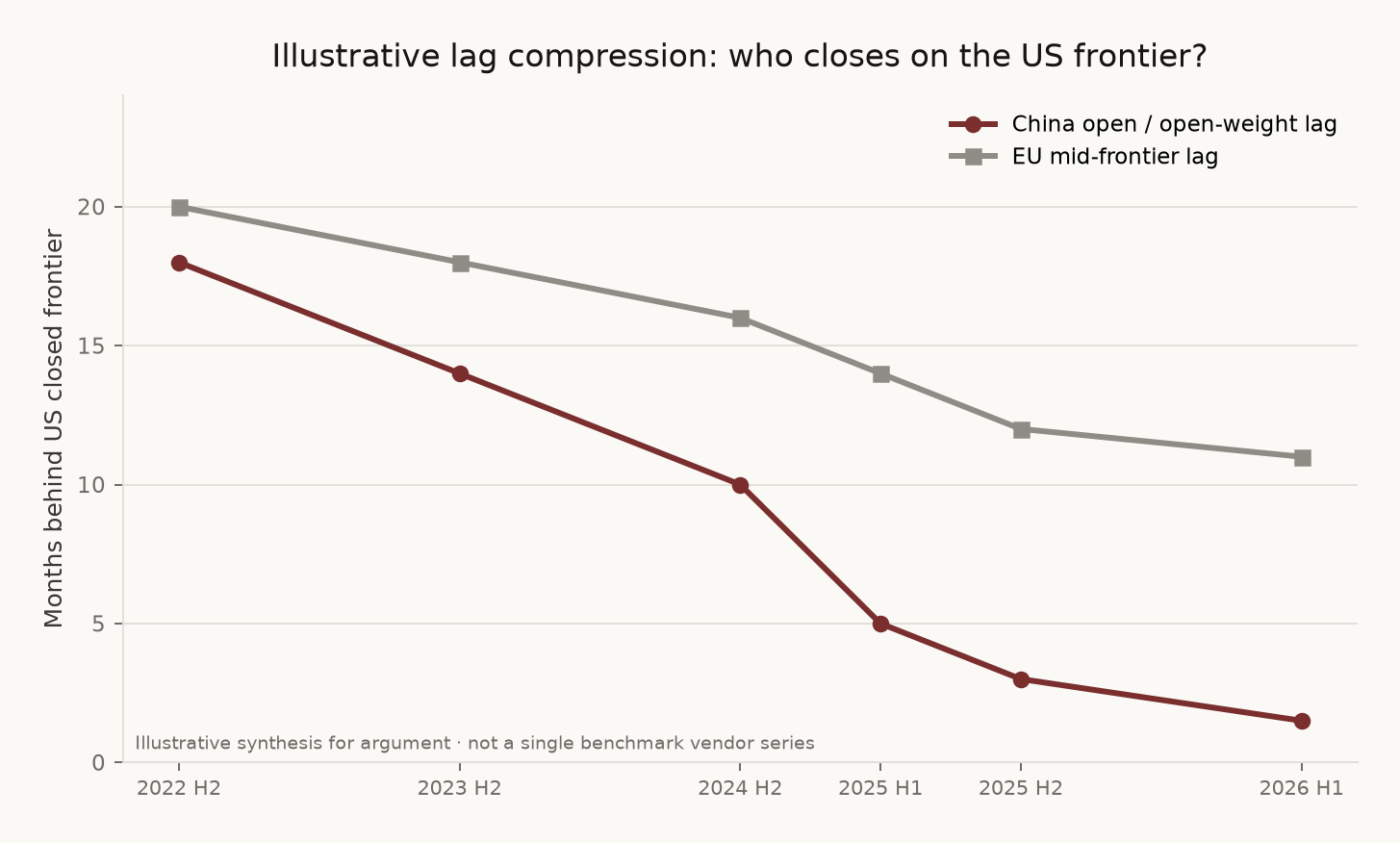
Figure 2. Illustrative months behind the US closed frontier. China open-weight compression is the shock of 2025–2026. EU mid-frontier improves more slowly.
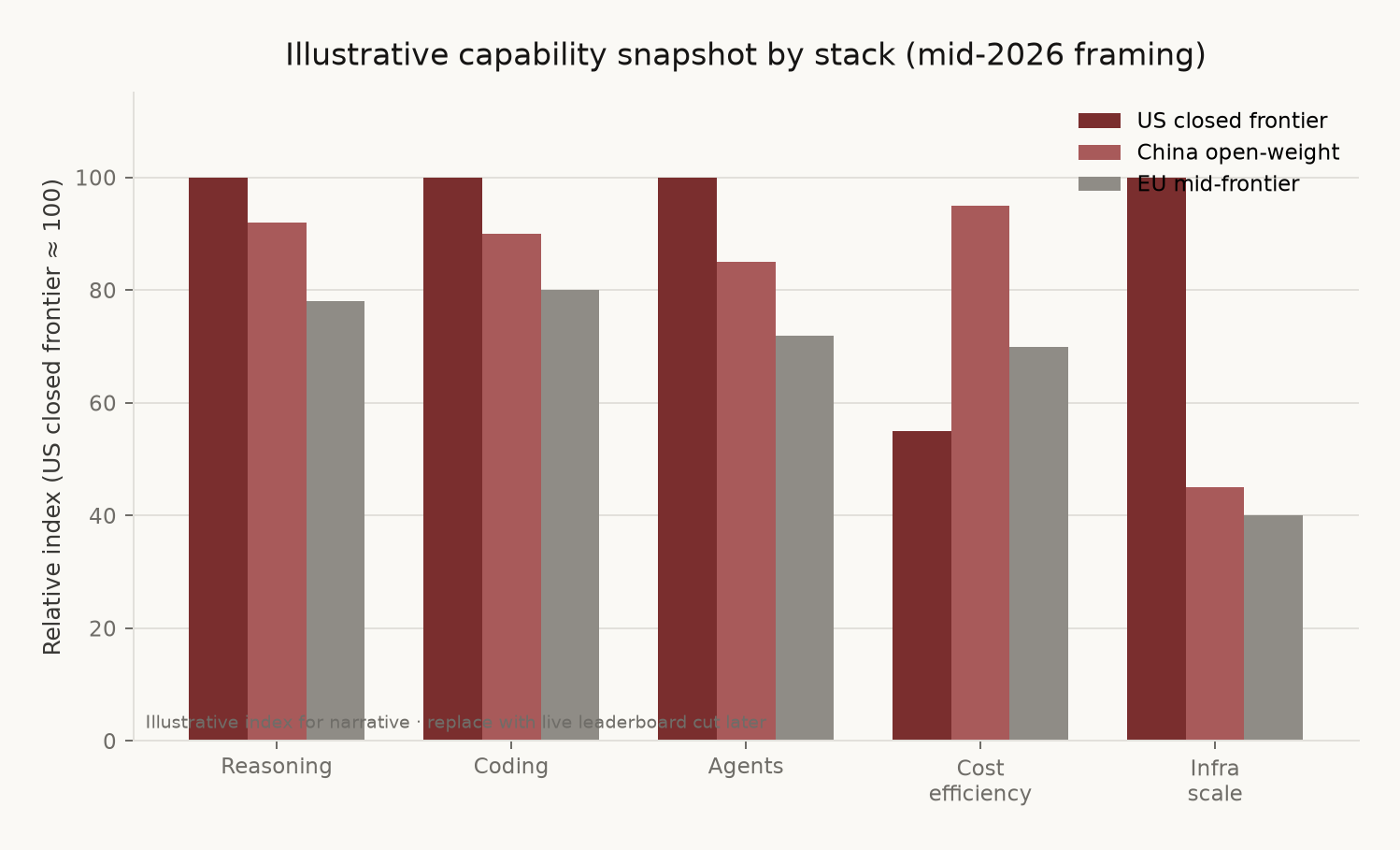
Figure 3. Illustrative relative index with US closed frontier ≈ 100. China looks close on capability and cost, weak on infra scale. EU sits lower on frontier ability and compute scale, higher on “safe adoption” narratives than on raw power.
How to read EU vs rest without self-deception:
- US closed: highest capability + infrastructure + enterprise distribution, under open-model pressure on price and retention.
- China open-weight: fast catch-up, aggressive release cycles, weaker ability to scale global inference (compute shortage).
- EU: regulation and trust as an enterprise adoption advantage, with the risk of becoming a safe market for foreign models rather than a producer of frontier intelligence. This is also where the Brussels Effect sits: the AI Act slows European development, but it gives Europe another weapon. US and Chinese firms that want to operate in Europe must follow European rules. Europe may not build the world’s best AI, but it effectively sets global standards for how AI may be developed and sold.
3. USA vs China: open models, infrastructure, and pace
Per Caleb Writes Code – “AI Race: Chinese open models just got real” – the open vs closed race is not only a benchmark fight. It is also a capital and political fight over who sets the tempo.
The open vs closed race is older than ChatGPT. Everyone likes open models: download, run locally or on your own servers. Closed labs privatized the most capable systems and sold them through APIs. From 2022, closed labs dominated frontier capability and consumer distribution.
The gap is compressing. Open models were once ~18 months behind, then a year, then months. With release cycles around Kimi K3 and Qwen-class models, open competition looks almost like a full frontier challenger. The DeepSeek moment (early 2025) showed low-cost reasoning catching closed reasoning and shaking markets. Kimi-class jumps then cut lag behind Anthropic Fable-class releases to roughly a month. That timing matters while closed labs prepare IPO stories that need investors to believe the model layer is durable and defensible.
USA: infrastructure and closed frontier
The US holds capital, chips, datacenters, talent, and enterprise distribution. Closed labs build premium businesses on the idea that frontier intelligence is not freely commoditized.
Open competition hits retention and revenue: why pay premium API rates if a strong open alternative exists? Labs respond with product and allowance refreshes to keep users. Availability regulation also raises the bar: closed models must stay clearly better than open, or customers leave.
Part of the US establishment therefore reads open labs not only as technical competition, but as deceleration of AI development: cheap abundant intelligence supposedly slows the next jump because it kills the appetite to fund frontier CapEx (Capital Expenditure: large upfront spending on datacenters, chips, and training infrastructure). After Kimi K3, that debate hardened around a July 2026 X thread from Dean Ball (OpenAI, Head of Strategic Futures). Ball calls Kimi a very good model (in agentic coding roughly on par with the best public models of Q1 2026) and still treats the open-weight strategy as a threat to the race’s tempo.
The logic is simple. If a strong model is free or self-hostable, willingness to pay premium for closed APIs falls. Expected returns on datacenters, chips, and training fall with it. Ball says it directly: open-weight is “inherently decelerationist” and “deter[s] further AI capex.” Closed labs need to believe the lead can be monetized. Otherwise investors will not finance the next mega clusters.
The endgame in that same thread is “full AI communism”: AI stops being a market product and becomes a “public good” / digital public infrastructure provided by the state. For Ball, that is dystopia. For part of the open-weight camp, it is closer to the implied destination. He also speculates that the US administration may create regulatory FUD (Fear, Uncertainty, Doubt: e.g. backdoors and compliance risk) around Chinese open models so regulated enterprises back off the open stack even without a hard ban.
Pushback was immediate. David Sacks wrote on X that the leading closed labs (already a duopoly in AI model revenue) want the government to eliminate their open-source competition. Acceleration vs deceleration is not about chip clock speed. It is about whether open-weight abundance kills financing for the next frontier jump.
For Europe the position is uncomfortable: it benefits from cheap open models for adoption, but lacks domestic frontier capacity that would set tempo. When the US closed camp pushes open down politically and China pushes open up productively, Europe sits in the middle again: buyer, regulator, not pace-setter.
China: open weights, weaker infrastructure
Chinese labs play the open / open-weight card aggressively. Even with chip export limits and training on older GPUs, they compress lag against the US closed frontier.
They have the opposite problem: compute shortage and weaker global inference scale. After demand spikes around major Qwen releases, new subscriptions were constrained because infrastructure could not absorb demand. China can “make” models faster than it can host the world’s usage.
For the West, that is strategic precisely because open availability plus rapid catch-up equals user migration away from closed labs, especially if US labs tighten global access.
Google sits partly outside the pain: own stack (TPUs, research, infra, ecosystem). If the model layer commoditizes, Google loses less than labs whose moat is mainly one premium model. Europe currently matches neither US infrastructure density nor Chinese open velocity. It sits beside both with regulation and trust, without the same compute and capital density.
4. VC capital in AI: an allocation thesis
If AI is a state game, capital is one of the main weapons. The EU’s problem is often misdiagnosed as “too little VC.” That is usually wrong. Europe can look fine on total AI funding. The real gap is what that money buys.
Europe is not starved of AI checks. It is starved of checks that pay for frontier model training: multi-hundred-million / billion-scale rounds for weights, clusters, and the lab that can stay months from the US closed frontier. The same capital machine is happy to fund:
- vertical AI (legal, health, finance, industry copilots on someone else’s base model),
- VLMs and multimodal product layers that wrap vision/language capability into a workflow,
- compliance, RAG, agents-for-enterprise, and tooling that makes foreign models usable inside European firms.
That is rational for a VC seeking IRR. It is weak for a bloc seeking sovereignty. You can have a busy AI scene and still not own the layer that sets prices, access rules, and dependency.
Working allocation thesis:
- USA: dense capital into foundation models plus datacenters / energy / chips. Mega-rounds sustain closed labs and infra. The app layer is huge, but it sits on a domestic frontier.
- China: capital and state support into labs pushing open-weight and fast releases, while trying to close the compute gap. Open strategy is partly a response to export restrictions and a way to win adoption without the same cloud dominance.
- EU: plenty of AI venture activity relative to the myth of “no funding,” but the mix is skewed to vertical AI, VLMs, and enterprise tooling. Frontier foundation-model and sovereign-infra shares stay thin. Result: a strong “AI for X” scene, a weak shot at owning the frontier model layer.
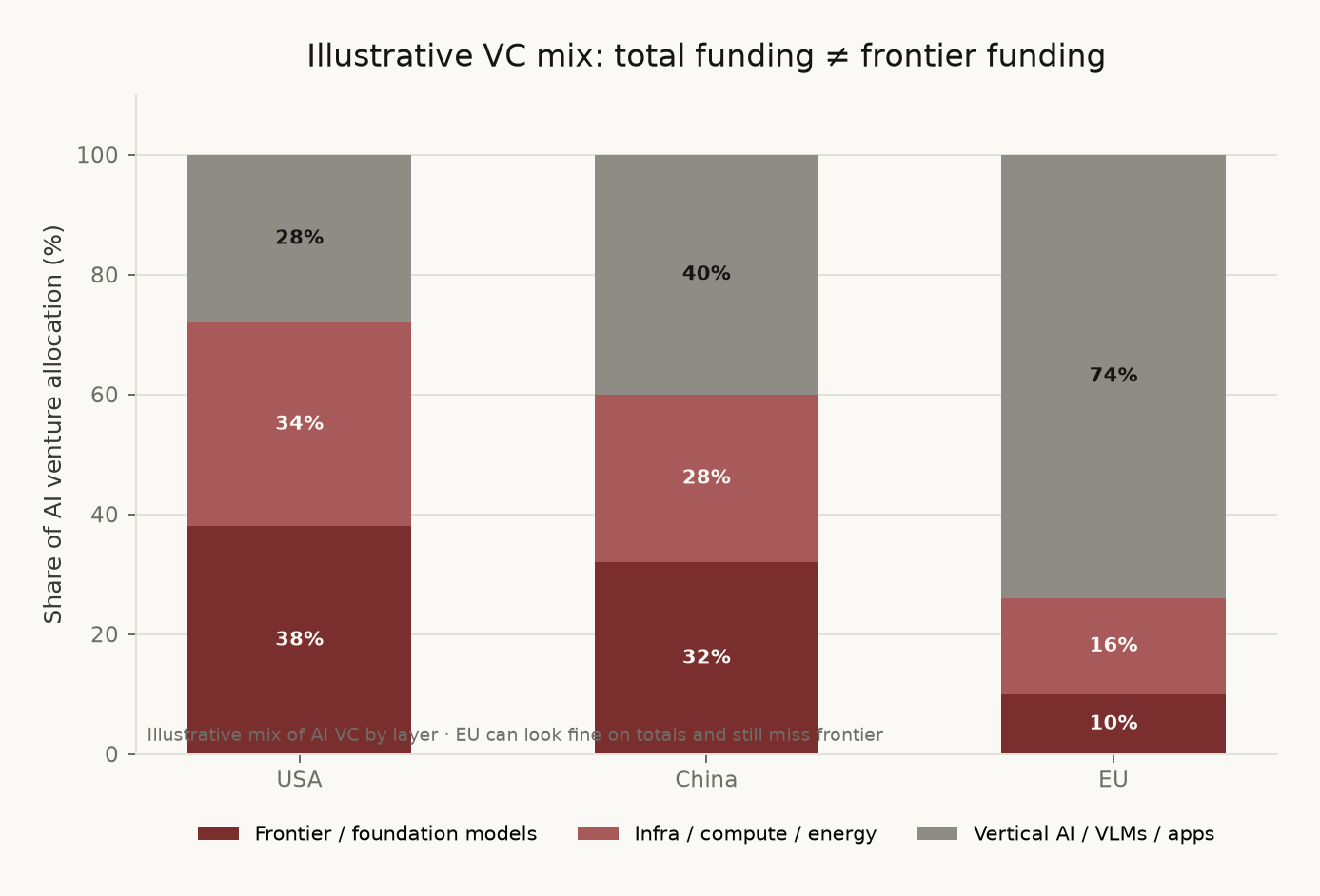
Figure 4. Illustrative share of AI venture allocation by layer (not total dollars). Bars = investment into the region / local AI dealflow (where money lands in the US, China, EU), not the passport of the VC fund’s HQ. The EU bar can coexist with healthy headline AI VC: the mix is app / vertical / VLM-heavy. The US bar is model- and infra-heavy. China sits between, with more open-model push than Europe and less infra depth than the US.
What follows for Europe: if the EU keeps allocating primarily into vertical products and VLMs on foreign bases, it may win short-term firm productivity and still lose the strategic layer: who owns weights, chips, datacenters, and the pricing of intelligence.
Allocation thesis in one line: Europe will not lose the AI race because it lacks VC. It will lose because capital and policy systematically underinvest the power layers (compute + frontier models) and overinvest the adoption layers (vertical AI + VLMs + compliance).
Europe lags in aggressive frontier innovation not because it lacks smart people, but because the system rewards all-in risk less. Life here is relatively good: a strong social buffer, more security, and less “win or fall” pressure. That is a civilizational win. It also reduces the appetite for frontier bets where you can burn capital, career, and reputation. America has harder conditions and a culture that normalizes that risk more: longer hours, sharper competition, more willingness to put everything on one lab. Worse conditions there paradoxically produce tempo.
The second problem is density. Europe has no European Silicon Valley. No European state has the Bay Area effect: labs, capital, talent, and “everyone is here” in one place. Without that gravity, it is hard to keep a frontier cycle at home. The best people then often leave for the US for two practical reasons. First, Europe is not the pinnacle of innovation, so a career on the absolute frontier is not the default path here. Second, almost nobody in Europe will offer the pay that US labs and big tech treat as a normal ticket into the game. When density and reward do not arrive, talent does not stay. And without talent, it is naive to expect vertical-AI VC alone to produce a European frontier.
That does not explain the compute gap by itself. It does help explain why Europe, even with decent funding, more often chooses safer adoption than a crazy frontier lab, and why talent and capital flow to where density and pay already exist. If Europe really wanted to pull a Mistral-class lab up, “more startups” would not be enough. It needs a place with density, pay competitive with the US, and capital into weights and compute, not only into wrappers.
Can the EU keep up with VLMs / vertical AI?
Yes on products. No on setting the pace.
European firms can keep up on adoption: fine-tunes, RAG, documents, agents, vertical workflows. The base today does not have to be Anthropic. It can be open-weight (Llama, Mistral, Qwen, DeepSeek…) or a closed API. So a VLM / vertical scene can exist without a domestic frontier lab.
But if Europe mainly builds on foreign (especially open) near-frontier bases, it stays structurally behind on the capability ceiling:
- You inherit the base model’s lag. Fine-tuning and document integration do not raise the reasoning / agentic ceiling by a generation. When Qwen / DeepSeek / Kimi jumps, the European product jumps with it. When those stay a month behind the US closed frontier, Europe stays there too.
- You do not set the tempo. Tempo is set by labs that train the next weights. Europe plays follow / adapt, not lead.
- Open China partly solves the problem and partly moves it. Open weights replace dependence on US APIs. They are not European sovereignty. Trust, licensing, supply-chain, and gov-procurement friction appear: critical infrastructure will not want to run blindly on a Chinese stack.
- This is not a 100% empty wrapper. Fine-tunes + data + integration are real value. They are still adaptation of finished intelligence, not ownership of the layer that produces that intelligence.
So: Can the EU keep up? Yes in applications. Not on the frontier if it stays in VLM / vertical mode on foreign open or closed bases. The business bet can work. The strategic bet “we remain a follower with trust friction” remains.
5. History of pace, and a prediction for Europe
AI’s recent history is a story of accelerating distribution and geopolitics, not only better loss curves.
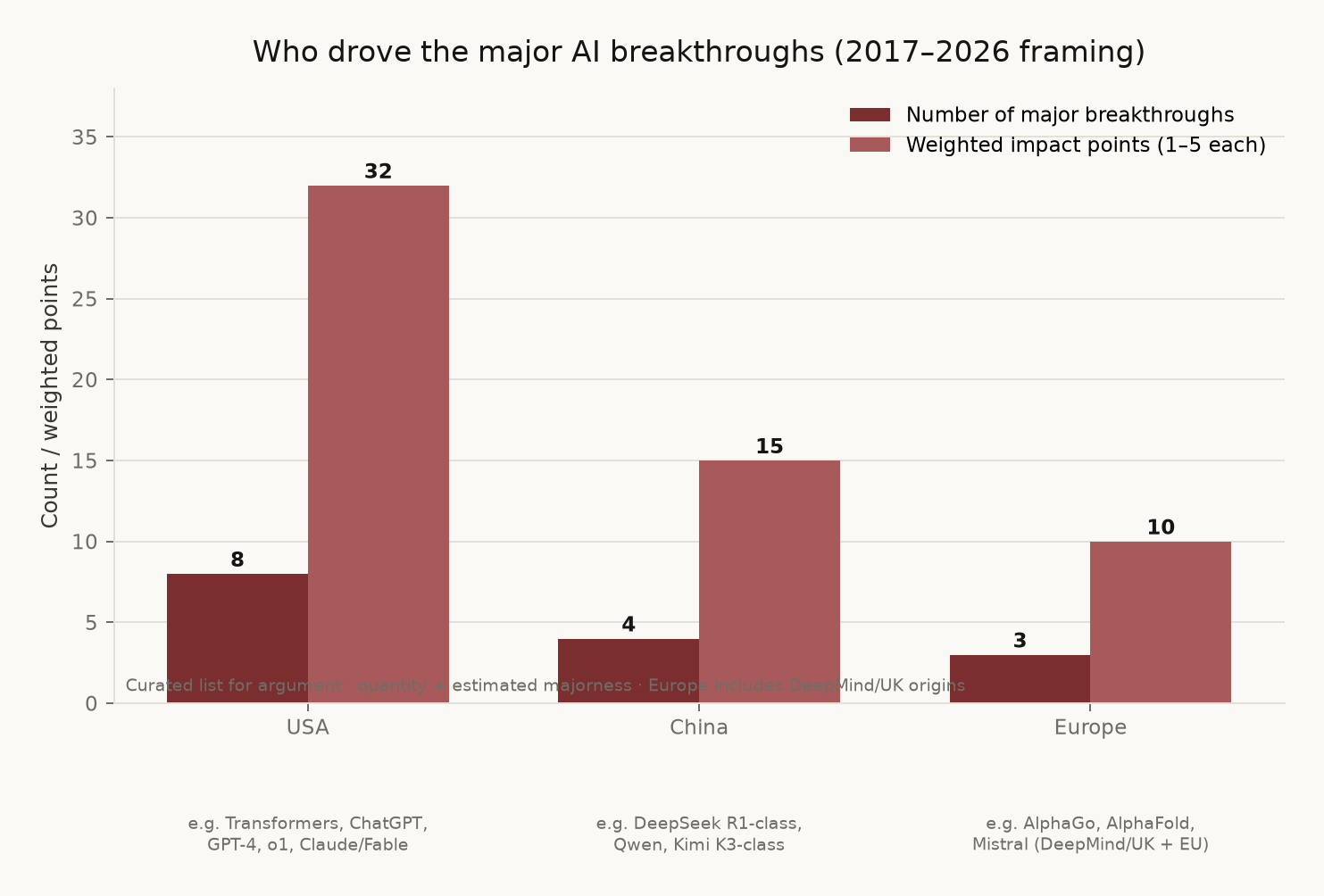
Figure 5. Curated major breakthroughs (2017–2026). Darker bar = event count. Lighter bar = summed “how much it moved the race” weight (1–5). Examples on the chart: USA (Transformers, ChatGPT, GPT-4, o1-class, Claude/Fable); China (DeepSeek R1-class, Qwen, Kimi K3-class); Europe incl. DeepMind/UK (AlphaGo, AlphaFold, Mistral). The US leads on both quantity and weight. China has fewer items but high weight on open-weight jumps. Europe has strong science landmarks and weaker frontier-product cadence.
Prediction: three paths, one uncomfortable paradox
The paradox first: Europe can “win” commercially and still lose strategically. Vertical AI and VLM startups can raise, ship, and exit while the continent remains a client of US closed weights or Chinese open weights. Headline AI success does not equal frontier sovereignty.
Horizon I care about: roughly the next 2–4 years (one funding + infra cycle), not a 2035 slogan deck.
Base case (most likely): the EU loses the absolute frontier race and keeps a strong application layer. Capital stays rational: more vertical AI and VLMs, few true frontier mega-rounds. European models stay mid-frontier: good enough for many workloads, not the system that sets the global pace. States buy and regulate foreign intelligence more than they train it. If access tightens, Europe feels dependency as a sudden shortage of substitutes.
Bull case (optimistic): allocation flips. EU-scale compute actually gets built and powered. At least one European lab gets frontier-density financing and stays within a few months of US closed models on hard agentic / reasoning tasks. Public procurement starts preferring domestic or open-sovereign stacks over wrapping GPT/Claude/Kimi. Vertical AI then sits on a European base, not only on imported ones. This needs capital + energy + talent density at once; regulation alone does not produce it.
Bear case (pessimistic): closed labs and US policy tighten European access while Chinese open models fill the gap on cost and availability. Europe becomes a premium compliance market for whoever still sells access, plus a large installer of Chinese open weights in private stacks. Local vertical AI thrives as a thin wrapper. Strategic autonomy becomes a speech, not a stack.
What “losing” means in the base case (explicitly):
- Europe remains a large buyer and regulator of foreign intelligence.
- European startups succeed in vertical domains, VLMs, and specialized workflows, not on the absolute frontier.
- The weights, clusters, and pricing power stay mostly US (closed) and increasingly contested by Chinese open ecosystems.
- If the US or frontier labs limit who in Europe may use their models, Europe feels that as dependence: it suddenly has nothing ready to replace foreign intelligence.
What would falsify the base case: a serious EU-scale compute buildout, frontier-lab financing at something closer to US density, and European models that stay within a few months of the closed frontier on hard agentic and reasoning workloads, not only on marketing demos or vertical leaderboards.
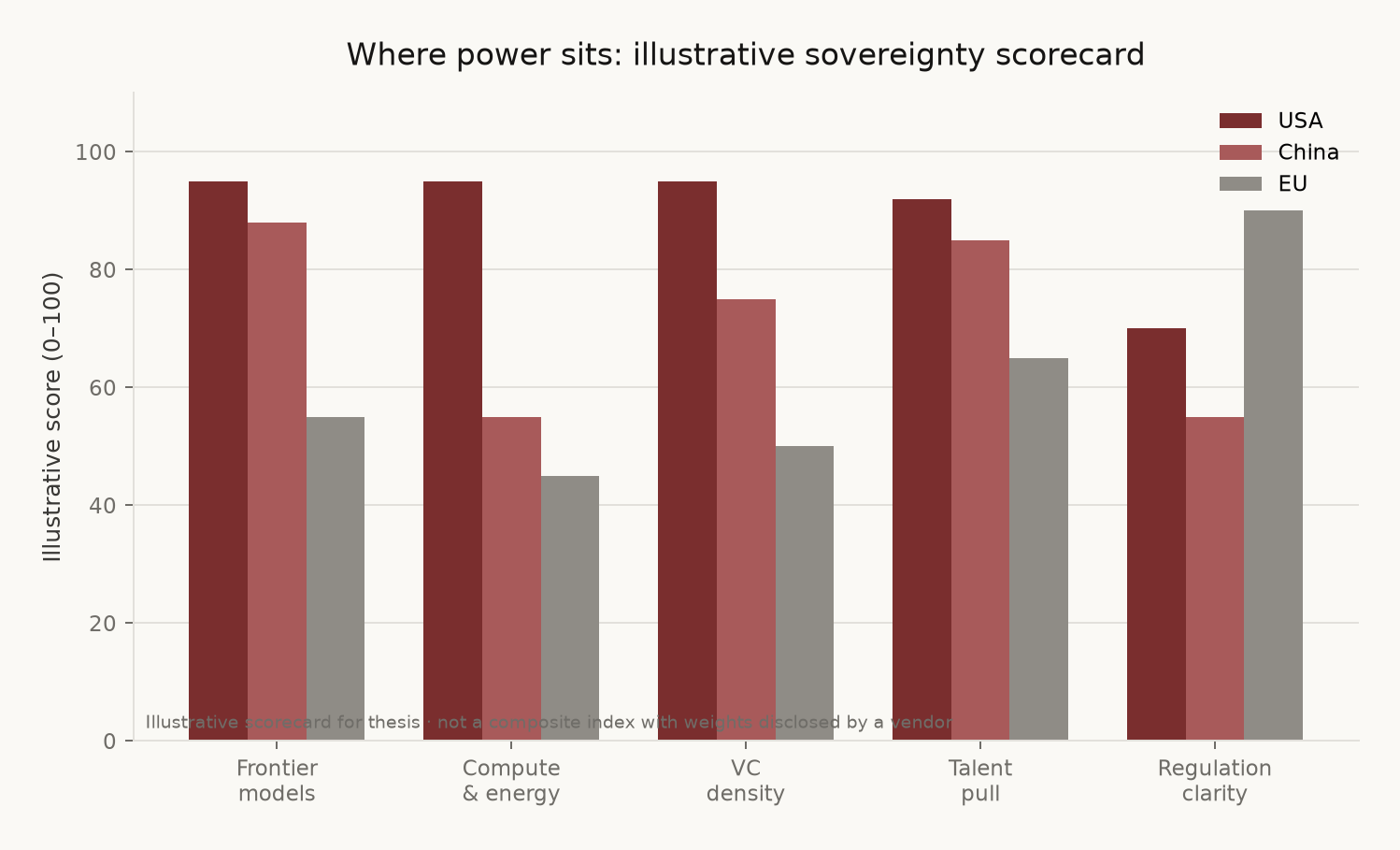
Figure 6. Illustrative scorecard. The US leads power layers. China is strong on models/talent pressure, weak on compute scale. The EU leads regulation clarity and lags where sovereignty is decided.
6. Government approach and AI inside the state
Beside the corporate race sits a second axis: how deeply states actually run AI inside their own systems. Not in strategy decks, but in taxes, digital identity, justice, public healthcare, urban administration, and internal security.
Four models, without hype:
- China leads on overall depth of state-run AI across tax, identity, and security stacks. The pattern is aggressive cross-agency data integration (including enforcement systems such as Golden Tax-style architectures). The state does not only “use” AI. It operates AI as an instrument of administration.
- Singapore is a strong Smart Nation reference: SingPass, digital services, urban administration. It scores high on identity, healthcare, and city systems. That is not magic and not the only model on earth. It is a small, centralized state with high digital density and a pro-innovation governance style that makes adoption easier than the EU’s hard-law path.
- USA has serious agency projects (including State Department tools such as StateChat) plus defense and tax deployments, but the stack is fragmented. The weakest point in this comparison is digital identity: the federal US does not have a Singapore/China-style unified national ID operating system.
- EU often leads on rules (AI Act, privacy) while average operational deployment into core systems is slower. It can constrain and audit AI before it can run AI as ordinary state capacity.
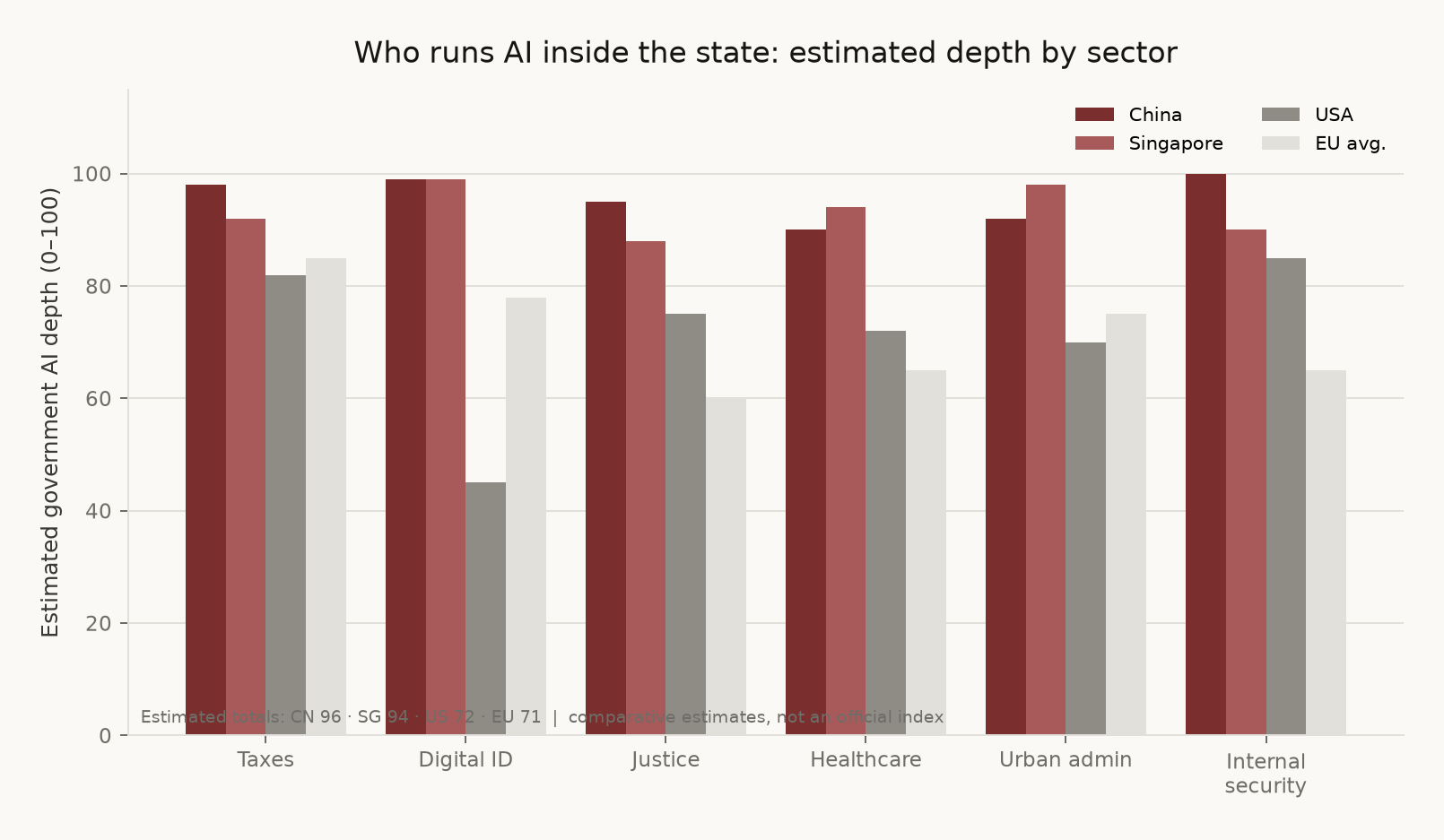
Figure 7. Estimated 0–100 scores by sector (taxes, ID, justice, healthcare, urban admin, internal security). Totals: China ~96, Singapore ~94, USA ~72, EU ~71. Comparative estimates, not an official single-agency index.
For Europe this is a second loss beside the frontier-model gap: even with good startups, without state demand and implementation there is no home market pulling European labs, data pipelines, and infra. A state that mainly regulates AI and rarely operates it raises an ecosystem dependent on foreign platforms.
Conclusion
AI in Europe is interesting because it is no longer a contest between companies. It is a question of whether a regulated continent can remain a player when intelligence is treated as strategic infrastructure.
The US has infrastructure and closed frontier labs under open-model pressure. China has open-weight velocity, a compute bottleneck, and the deepest state operation of AI in administration. Singapore shows an efficient Smart Nation path, not a universal recipe. Europe has rules, trust, the Brussels Effect (standards for foreign labs), and often enough AI VC that still misses frontier models because it prefers vertical AI and VLMs. Unless that mix and state implementation change, Europe can look commercially busy, dictate compliance, and still lose the layer that sets the terms of the race.
This draft is meant to be edited: swap remaining illustrative charts for live data cuts, harden the Anthropic / export claims with primary citations, and pressure-test the VC shares against a real capital dataset.